
ULTHERA DS 7-4.5 & DS 10-1.5N: Lower Face ROI & Price Guide
For cervical and submental laxity, the ULTHERA DS 7-4.5 and DS 10-1.5N transducers work best as a paired protocol: 4.5 mm energy engages SMAS and platysma vectors in the lower face and neck, while…
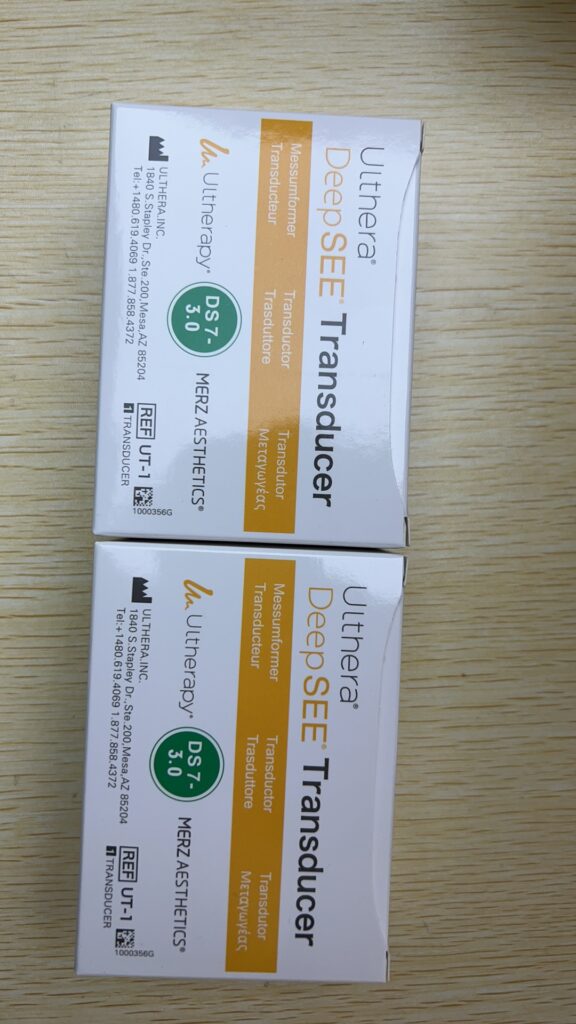
For cervical and submental laxity, the ULTHERA DS 7-4.5 and DS 10-1.5N transducers work best as a paired protocol: 4.5 mm energy engages SMAS and platysma vectors in the lower face and neck, while 1.5 mm ultrasound polishes the dermis and subdermal plane along the jawline. This deep–shallow combination supports jawline contouring and neck crepiness work without promising specific outcomes, and can justify console and transducer investment when you model pricing, utilization, and sourcing across new and certified pre-owned units.
What These Transducers Do & Who They’re For
The ULTHERA DS 7-4.5 transducer is a DeepSEE cartridge designed to deliver microfocused ultrasound energy at approximately 4.5 mm focal depth, targeting the SMAS and fascia near the platysma in lower face and submental regions. It uses a 7 mm footprint to create lines of thermal coagulation in deep planes that support non-invasive vectoring along jawline and cervical contours.
The ULTHERA DS 10-1.5N is a 10 MHz, narrow-footprint transducer that treats at roughly 1.5 mm depth, engaging the dermis and very superficial subdermal tissues along small, curved fields such as the mandibular border, under-chin skin, and periorbital areas. Its role in lower face work is not fat removal but dermal quality and fine contour refinement in regions where skin is thinner and texture changes are easily perceived.
Clinics best suited to this combination are those offering Ultherapy Prime or similar advanced Ulthera protocols for jawline definition, double-chin contouring in mild-to-moderate laxity, and neck crepiness, especially where patients want non-surgical interventions. These are typically dermatology practices, medspas, and facial plastic surgery centers already comfortable with SMAS targeting and looking to refine their protocol architecture rather than adding another device category.
Technical Core: Jawline Vectors, Platysma Bands, and Deep–Shallow Layering
In lower face and neck work, jawline contour and cervical skin tone depend on three interacting elements: SMAS/platysma support, subcutaneous fat distribution, and dermal integrity. The DS 7-4.5 transducer focuses on SMAS and fascia near the platysma, generating thermal coagulation points that can influence mechanical support vectors along the mandibular border and under-chin region, while leaving superficial tissues largely intact.
The DS 10-1.5N transducer, by contrast, deposits energy within the dermis, stimulating collagen remodeling and localized tightening while affecting fine lines, texture, and crepiness rather than deep lift. Multiple clinical and practice-based sources describe using a combination of 1.5 mm, 3.0 mm, and 4.5 mm transducers to treat various layers of the face and neck, with the 4.5 mm cartridges focusing on SMAS and deeper lifting, and shallower cartridges focusing on dermal quality.
For jawline contouring and submental laxity, a typical mechanical rationale is:
- Map vectors along the mandibular border and under-chin region based on anatomical lines of tension and platysma orientation.
- Use DS 7-4.5 to create deep coagulation lines near SMAS/platysma, focusing on lower face and upper neck where laxity is most visible and bone must be avoided.
- Follow, in selected cases, with DS 10-1.5N passes along the same or slightly offset vectors to compact the dermis and perceptually “sharpen” jawline and anterior neck texture, particularly for crepiness.
Microfocused ultrasound studies of the lower face show measurable changes in skin laxity and contour over several months, with protocols commonly using 3 mm and 4.5 mm depths; layered approaches aim to distribute energy across multiple planes for structural and textural effects. The Ulthera system’s imaging capability (DeepSEE) supports these protocols by allowing visualization of tissues up to about 8 mm below the surface, helping clinicians avoid bone and confirm proper coupling before delivering lines.
This mechanical understanding matters for procurement: you are not simply buying “double chin removal” devices, but a transducer pair that lets you construct and stabilize treatment vectors in deep and shallow planes, provided protocols stay within labeled indications and no specific clinical result is promised.
Revenue and Payback Math for Lower Face Work
Ultherapy and similar HIFU/MMFU treatments for lower face and neck typically occupy high-fee slots in clinic menus, positioned as non-surgical contouring and tightening options for mild-to-moderate laxity. Incorporating both DS 7-4.5 and DS 10-1.5N into lower-face protocols can increase perceived sophistication and justify premium pricing, even though actual outcomes depend on patient selection and cannot be guaranteed.
Illustrative, non-binding economics for a mid-volume practice might look like:
- Lower face and neck Ultherapy sessions priced around USD 1,500–2,500 per treatment, dependent on region and positioning.
- 10–25 such sessions per month once the service is fully built out, with a significant subset using both DS 7-4.5 and DS 10-1.5N as part of multi-layer treatment mapping.
- Incremental perceived value from dermal refinement (1.5 mm passes) helping clinics maintain prices towards the upper end of local ranges, though financial performance still depends on actual demand and retention.
On the cost side, the Ulthera console represents the largest fixed investment, with new DS 7-4.5 transducers often listed in the USD 3,000–4,500 range and DS 10-1.5N generally around USD 2,500–3,200 in primary markets, with variation by supplier and line-count package. Certified pre-owned transducers may be available at approximately 40–70% of new pricing, tied to remaining line counts, refurbishment scope, and warranty terms. (These ranges are estimates drawn from market listings; clinics must verify current figures.)
The payback model for lower face Ultherapy should incorporate:
- Fixed capital: console plus an initial set of DS 7-4.5 and DS 10-1.5N transducers.
- Variable cost: per-line usage across both depths, including eventual replacement and refurbishment.
- Revenue: lower face/neck packages with clear internal protocols that utilize both depths to support vectoring narratives and justify tiered pricing.
ALLWILL can help clinic owners turn these data points into a true payback scenario, matching expected patient volumes and protocol mix with transducer inventory and lifespan rather than quoting hardware in isolation.
Request a quote from ALLWILL if you want DS 7-4.5 and DS 10-1.5N pricing presented alongside utilization, payback, and CPO condition modeling for your specific market.
Differentiated Advantage and High-Ticket Rationale
Many HIFU and MMFU platforms advertise lower face and neck tightening, but Ulthera’s combination of imaging and defined transducer architecture offers a more structured way to design protocols. The DS 7-4.5 transducer provides standardized SMAS targeting near platysma in lower face and submental regions, while DS 10-1.5N addresses superficial layers and texture, making them complementary tools for jawline and cervical work.
Clinical literature on microfocused ultrasound for lower face tightening highlights improvements in laxity and contour that develop over months, with protocols often using multiple depths to distribute thermal coagulation across different planes. Practice-based guides emphasize that a combination of 1.5 mm, 3.0 mm, and 4.5 mm transducers is commonly used in a single session to treat both SMAS and dermis. This multi-layer strategy differentiates Ultherapy-style approaches from devices that only offer a single focal depth or lack imaging for tissue visualization.
In procurement terms, the differentiated advantage is not just clinical but operational: Ulthera’s standardized cartridge ecosystem (including DS 7-4.5 and DS 10-1.5N), imaging, and treatment guidelines enable reproducible, protocol-driven lower-face work across clinicians and locations. Clinics can treat transducers as program components within a broader asset strategy, rather than ad-hoc accessories.
ALLWILL’s solutions positioning matches this reality by helping buyers think in terms of protocol architecture, transducer mix, and asset management instead of one-off hardware purchases.
Lower-Face Protocol Planning Framework (Jawline & Neck)
Because this topic centers on treatment planning rather than cost or logistics alone, the most useful decision aid is a tactical framework for designing lower-face protocols using DS 7-4.5 and DS 10-1.5N within realistic operational constraints.
Jawline & Cervical Ultherapy Protocol Planning Framework
- Patient selection criteria
- Focus on mild-to-moderate cervical and submental laxity with reasonably preserved volume; severe laxity or major submental fat may require other or combined approaches.
- Anatomical mapping and vector design
- Map jawline, under-chin, and anterior neck into zones based on platysma orientation, fat distribution, and skin thickness; define mechanical vectors that respect anatomical safety, avoiding bone and vital structures.
- Device and transducer stack
- Confirm Ulthera console capabilities and availability of DS 7-4.5 and DS 10-1.5N transducers in appropriate condition (new or CPO) with documented line counts and warranty.
- Depth allocation strategy
- Assign DS 7-4.5 passes to deeper SMAS/platysma zones in lower face and submental area; reserve DS 10-1.5N for superficial dermal refinement in jawline and crepey neck areas where texture and thin skin are prominent.
- Energy and line-count planning
- Estimate line numbers per zone and per depth based on manufacturer guidance and clinical best practices; align these with transducer line capacity and replacement timelines.
- Coupling and imaging protocol
- Standardize coupling gel type, thickness, and reapplication, and require DeepSEE imaging checks to confirm tissue planes and avoid bone before delivering lines.
- Pricing and tiering structure
- Design tiered lower-face/neck packages that clearly differentiate simple SMAS-focused treatments from multi-layer protocols, using internal language around layers and vectoring rather than outcome guarantees.
- Follow-up and evaluation schedule
- Set expectations for evaluation at three months and beyond, consistent with HIFU literature; incorporate standardized image-based assessments to track contour and laxity changes.
- Asset tracking and maintenance
- Integrate transducer usage logs, line-count tracking, and maintenance schedules into the clinic’s asset register; link DS 7-4.5 and DS 10-1.5N usage to specific protocols for better forecasting.
- Training and SOPs
- Develop written SOPs on jawline and neck mapping, depth selection, coupling, and safety checks; include Ulthera-specific steps and use these documents in onboarding and ongoing training.
ALLWILL can help clinics formalize this framework into practical SOPs and asset plans, bundling transducer procurement with protocol design support, training recommendations, and maintenance scheduling.
Compliance and Asset Protection for Lower-Face Ultherapy
Ulthera-based Ultherapy systems hold FDA 510(k) clearance for specific non-invasive lifting indications such as brow, submental, and neck lifts and for improving the appearance of lines and wrinkles on the décolletage, with DeepSEE imaging supporting safe visualization of tissues. Clinics must verify the exact regulatory status of their console, transducer set, and any regional variations before deploying lower-face and neck protocols, especially cross-border.
Asset protection in this context means:
- Verifying authenticity and traceability for each DS 7-4.5 and DS 10-1.5N transducer, including serial numbers, manufacturing dates, and sourcing channel.
- Ensuring regulatory documentation and IFU materials for the Ulthera system are current and filed within the clinic’s compliance archive.
- Obtaining written warranty terms for both console and transducers, including any specific line-count or time-based limitations.
- For certified pre-owned units, requesting refurbishment reports, test results, and condition grading to understand exactly what has been done to each cartridge.
ALLWILL can facilitate verifiable, documentation-first sourcing by requiring such records from suppliers and organizing them for buyers, but clinics must still treat regulatory confirmation and asset tracking as internal responsibilities.
Request a quote from ALLWILL if you want lower-face Ultherapy hardware sourced with accompanying warranty, refurbishment, and regulatory documentation tailored to your jurisdiction and risk profile.
Procurement Risks to Avoid and ALLWILL Expert View
Key risks in procuring DS 7-4.5 and DS 10-1.5N transducers for lower-face work include buying from unverified channels, ignoring transducer condition and remaining line counts, and underestimating the importance of protocol alignment and training. Another risk is overselling “double chin removal” or jawline tightening as guaranteed outcomes, which can create misaligned expectations and regulatory exposure.
Clinics may also attempt to stretch transducers beyond recommended line usage to save cost, increasing variability in acoustic delivery and patient experience. Deploying refurbished units without clear test results and refurbishment documentation similarly introduces uncertainty into a high-visibility treatment zone.
ALLWILL Expert View: Building a Jawline & Neck Asset Strategy
From an asset perspective, lower-face Ultherapy is not just a console and a handful of cartridges; it is a protocol-driven service line anchored by specific depths and mechanical narratives. DS 7-4.5 and DS 10-1.5N have distinct roles in this architecture—deep SMAS/platysma vectoring and superficial dermal refinement—and your procurement plan should mirror that duality. Rather than ordering transducers opportunistically, we recommend mapping your jawline and cervical protocols first: define which depths you will use in each zone, how many lines per treatment, and what utilization you expect over a year. Only then do you specify how many new and CPO cartridges you need in rotation, with what line-count buffers.
ALLWILL’s experience is that clinics who treat lower-face Ultherapy transducers as coordinated assets—with line-count logs, refurbishment documentation, and maintenance schedules—see fewer surprises in uptime and patient experience. The quote process becomes a design step for your jawline and neck program, not just a price check. Structuring procurement this way protects your brand position in a competitive HIFU/MMFU market and keeps you within your risk and compliance tolerances without relying on any outcome guarantees.
If you are expanding into cervical and submental Ultherapy, ask ALLWILL for a transducer and protocol proposal that explicitly couples DS 7-4.5 and DS 10-1.5N with your intended jawline and neck treatment strategy.
Frequently Asked Questions
What is the typical price range for DS 7-4.5 and DS 10-1.5N?
New DS 7-4.5 transducers frequently appear around USD 3,000–4,500, while DS 10-1.5N cartridges are often listed around USD 2,500–3,200 depending on supplier and line-count package. Certified pre-owned units can be lower, but exact pricing should be confirmed via a quote request.
How do new and certified pre-owned Ulthera transducers compare for lower-face work?
New cartridges offer full manufacturer warranty and predictable starting line counts, whereas certified pre-owned units can reduce capital outlay if refurbishment and testing are well documented. Clinics should compare remaining lines, membrane condition, and warranty terms in writing and can use ALLWILL to obtain structured CPO inspection summaries.
What regulatory considerations apply to jawline and neck Ultherapy?
Ulthera systems carry specific FDA 510(k) clearances and labeling for non-invasive lifting and related indications, but clinics must confirm that their particular console and transducer set are appropriately cleared or authorized in their region for intended use. Regulatory documentation should be reviewed and filed as part of procurement.
What ROI or payback timeline might I see for lower-face Ultherapy with dual depths?
ROI depends on session pricing, patient demand, and utilization across the lower face and neck menu. Many practices position dual-depth protocols to support premium tiers, but income is never guaranteed; a tailored payback model from ALLWILL can help estimate timelines under your local conditions.
What lead times and service requirements should I expect for these transducers?
Lead times for new DS 7-4.5 and DS 10-1.5N cartridges vary by region and stock, while certified pre-owned units may depend on refurbishment schedules. Buyers should clarify delivery timelines and service options in quotes and align them with maintenance plans to prevent treatment interruptions.
References
-
Introduction of the 1.5mm Shallow Transducer – Ulthera White Paper
-
Three-dimensional Analysis of Lifting Effects after High-intensity Focused Ultrasound
-
High-Intensity Focused Ultrasound (HIFU) for Facial Skin Tightening – Systematic Review
-
Markham Ultherapy Prime – 7th-Generation Focused Ultrasound Overview
-
Ulthera DeepSee DS 10-1.5N Narrow Transducer – Listing and Specifications
-
Ultherapy DeepSEE DS 7-4.5 (Purple) Transducer – Product Details
Related articles
Ultherapy Transducers: What the Probe Record Changes About the PriceBrand and Model Buying Guides Candela GentleMax Pro: Demand, Verification and Cost Before You CommitBrand and Model Buying Guides
 Alma VH1160 Vector Handpiece Code: What the Part Number Tells a BuyerBrand and Model Buying Guides
 DEKA Onda Pro: Investment Case, Verification and Pre-Owned RealityBrand and Model Buying Guides