
ULTHERA DS 10-1.5N Transducer: Technical Coupling, Dermal Wheals, and Asset-Protective Procurement
Maintaining uniform, light transducer coupling pressure with the ULTHERA DS 10-1.5N is critical to prevent dermal wheals, superficial burns, and energy refraction during periorbital and other superficial passes. For clinic owners, this is not…
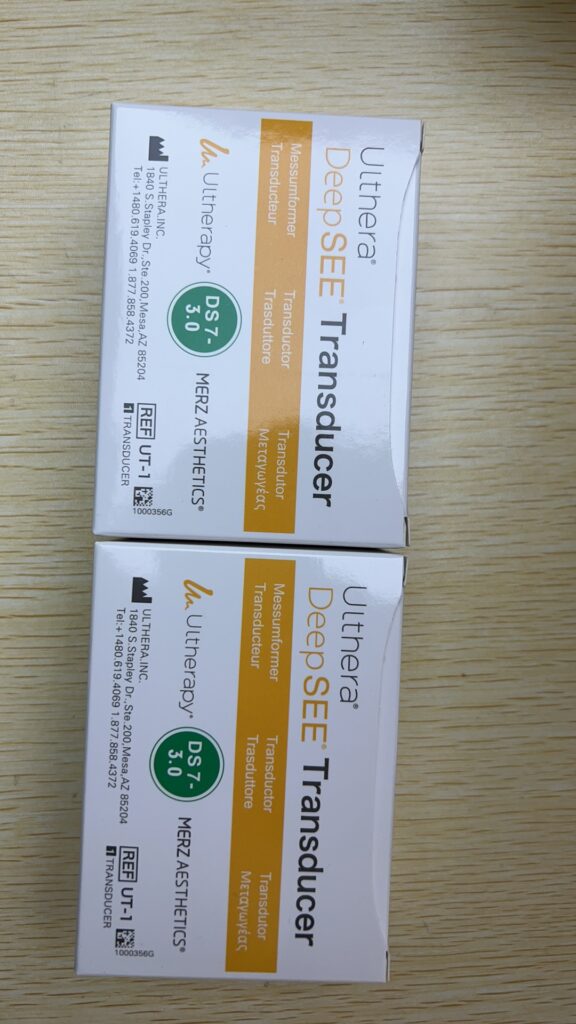
Maintaining uniform, light transducer coupling pressure with the ULTHERA DS 10-1.5N is critical to prevent dermal wheals, superficial burns, and energy refraction during periorbital and other superficial passes. For clinic owners, this is not just a technique issue but a hardware, gel-physics, and uptime question: selecting the right DS 10-1.5N units (new or certified pre-owned), enforcing coupling protocols, and aligning service/maintenance support directly impact safety, treatment consistency, and long-term return on investment.
What the ULTHERA DS 10-1.5N Does & Who It’s For
The ULTHERA DS 10-1.5N transducer is a 10 MHz, narrow-footprint DeepSee ultrasound cartridge engineered to deliver micro-focused ultrasound energy at approximately 1.5 mm depth, primarily targeting superficial dermal and subdermal structures. It is commonly used for fine-line polishing, periorbital tightening, and small-field contouring in advanced aesthetic clinics and dermatology practices that already understand Ultherapy’s deeper transducers and want more precise superficial passes.
Clinics that benefit most from this handpiece are those with high patient demand for eye-area refinement, “polishing” passes after deeper lifting, and combination protocols with lasers or RF where dermal integrity is paramount. For these operators, coupling performance and transducer condition are directly tied to avoiding wheals, post-treatment erythema clusters, and rare but impactful superficial burn events.
Technical Core: Coupling Pressure, Gel Physics, and Energy Refraction
From a hardware-physics standpoint, the DS 10-1.5N sits at the intersection of high-frequency ultrasound, a narrow contact footprint, and shallow treatment depth—meaning small deviations in coupling pressure and gel continuity have amplified clinical consequences. Ulthera’s Instructions for Use explicitly instruct clinicians to maintain a light, constant pressure and keep the hand still when delivering treatment lines, emphasizing the sensitivity of superficial passes to variations in contact.
Air is an acoustic insulator; microscopic air gaps between the DS 10-1.5N membrane and skin reflect ultrasound energy instead of transmitting it, leading to refraction, hot spots, and inconsistent focal deposition. High-quality coupling gel acts as a conductive bridge that displaces air and prevents microbubble formation, which is critical in HIFU/MFU systems to avoid localized superheating at the skin surface. When coupling pressure is uneven—too light in some areas, too heavy in others—gel thickness and continuity vary, increasing the risk of dermal wheals (raised, localized edema within the superficial treatment plane) and transient or, in rare cases, more severe skin injury.
Clinically, many “mystery” wheals following superficial Ultherapy passes can be traced back to three controllable variables: transducer face condition, gel application, and operator pressure dynamics. Worn membranes, scratched housings, or inconsistent gel coverage interact with irregular pressure to change the effective beam profile, producing focal-intensity peaks that the superficial dermis cannot dissipate evenly. For a procurement-minded clinic owner, this is a strong case for tying training, consumables, and transducer condition verification into the purchasing decision rather than seeing cartridges as simple disposables.
Revenue, Uptime, and Payback Math Behind DS 10-1.5N Use
While the DS 10-1.5N is not a standalone revenue generator like a full Ulthera console, it materially shapes utilization and perceived quality of your Ultherapy menu. Reliable superficial passes support higher patient satisfaction scores, stronger word-of-mouth, and the ability to package periorbital refinement as a premium add-on or component of tiered Ultherapy protocols.
A reasonable illustrative model for a mid-volume medspa might assume:
- 20–40 Ultherapy patients per month once the service is fully launched, with 40–60% receiving DS 10-1.5N superficial passes as part of their protocol.
- Incremental periorbital/small-field revenue of an estimated USD 150–350 per patient, depending on geographic market and bundling strategy. (Estimate based on typical Ultherapy menu structures; clinics must validate against local pricing.)
Under that range, incremental superficial-pass revenue could approximate USD 1,800–8,400 per month, contingent on utilization and pricing. (Illustrative, not guaranteed.) Coupling-related complications—wheals that require follow-up, scattered superficial burns, or “rough” treatments—reduce effective capacity and may lead to refunds or discounts, eroding margin and clinician confidence. Ensuring device uptime and coupling integrity through quality sourcing and preventive maintenance allows those incremental revenues to track closer to plan.
From a capital perspective, the console investment is substantial, but individual new DS 10-1.5N transducers are commonly listed around USD 2,500–3,200 per cartridge in primary and secondary markets, with line-count depreciation over time. For certified pre-owned (CPO) or surplus units, clinic buyers may see typical ranges between USD 1,400–2,300 depending on remaining line capacity, refurbishment scope, and warranty. (Illustrative ranges derived from resale market signals; exact pricing must be confirmed at quote.) When a transducer directly affects patient comfort and perceived quality in a highly visible area, the payback calculus includes avoided complications and brand protection as much as direct incremental revenue.
Mid-funnel buyers often find value in solutions platforms like ALLWILL that can model utilization scenarios, line-count economics, and maintenance intervals rather than simply quoting cartridge prices. ALLWILL’s Smart Center support and expert-matching can help align DS 10-1.5N procurement with realistic patient-volume assumptions and service planning, which is often the difference between a smooth payback period and underutilized capital.
Request a quote from ALLWILL for current DS 10-1.5N pricing, CPO availability, and projected payback under your actual patient volumes.
Why DS 10-1.5N Deserves High-Ticket Attention
At first glance, the DS 10-1.5N can look like a simple “extra” in the Ulthera ecosystem, overshadowed by deeper transducers such as the DS 4-4.5 used for SMAS lifting. However, in practice, the superficial narrow transducer is often where patients feel the most detail, refinement, and comfort—or discomfort—because it works close to sensory-rich superficial tissues.
The narrow footprint allows more targeted energy delivery in curved, tight spaces like the periorbital area, upper lip, and small facial subunits where a standard-width cartridge would be cumbersome. Combined with Ulthera’s imaging, the DS 10-1.5N enables real-time visualization of dermal and subdermal layers up to several millimeters below the surface, helping clinicians confirm coupling and avoid bone during passes. This is particularly important around the orbital rim, where inadvertent energy deposition into bone or poorly coupled interfaces can produce painful hot spots and unpredictable wheals.
Compared with generic HIFU devices that lack integrated imaging, the DS 10-1.5N on an Ulthera platform offers a more controllable interface between transducer, gel, and tissue. That control is an operational asset: when your team can see coupling issues and adjust pressure in real time, you reduce the probability of complications and improve the reproducibility of superficial protocols. For clinic owners, this supports premium pricing and stronger brand positioning, provided the transducer itself is in good mechanical and acoustic condition.
BME Technical Maintenance Checklist: DS 10-1.5N Coupling and Safety
Because this article’s focus is technical specs, engineering, and side-effect prevention, the most useful decision aid is a BME-led maintenance checklist that operationalizes coupling physics into routine inspections.
DS 10-1.5N Technical Maintenance Checklist (For BME / Clinical Operations)
- Transducer face inspection
- Check membrane for micro-tears, scratches, or discoloration before each treatment day; retire or service any cartridge with visible defects.
- Housing and connector integrity
- Verify that the cartridge locks firmly into the Ulthera handpiece without wobble, and that connector pins are clean and undamaged.
- Line-count and usage tracking
- Maintain a log of delivered treatment lines per cartridge, comparing with manufacturer specifications and internal thresholds for retirement or refurbishment.
- Imaging and coupling verification
- Use DeepSee imaging to visualize dermal layers and confirm uniform coupling before treatment lines, especially over bony structures.
- Gel specification and stock management
- Standardize on a high-quality, ultrasound-appropriate coupling gel with documented acoustic properties; avoid low-viscosity, dried, or expired gels.
- Gel application protocol
- Enforce a protocol specifying gel thickness ranges and reapplication intervals, with training on continuous coverage and avoidance of trapped air pockets.
- Operator pressure training
- Audit clinicians’ technique to ensure light, constant transducer pressure and minimal lateral movement during line delivery, consistent with IFU guidance.
- Thermal event reporting and review
- Document any patient reports of “hot spots,” wheals, or burns, linking events to transducer ID, gel batch, and operator; use findings to adjust protocols.
- Scheduled service and calibration
- Coordinate periodic checks with service providers or platforms like ALLWILL to validate console output, handpiece performance, and transducer acoustic consistency.
- Documentation and compliance file
- Keep records of transducer serials, acquisition source, refurbishment reports, and maintenance logs in a central compliance file accessible for audits.
Treating this checklist as a mandatory operating standard rather than an optional reference is what separates a high-reliability Ultherapy program from a cluster of individual treatments with variable safety profiles. ALLWILL can help clinics formalize such checklists into SOPs and integrate them with asset registers, warranty schedules, and recurring service plans.
Compliance and Asset Protection Around Ultherapy and DS 10-1.5N
Ulthera-based Ultherapy systems have an established regulatory history, including FDA 510(k) clearances for non-invasive lifting of the brow, submental, and neck regions and for the appearance of lines and wrinkles on the décolletage. However, specific transducer configurations and regional indications can vary, so buyers must always verify the current regulatory status of the device and transducers for their jurisdiction prior to purchase or import.
Any acquisition—new or CPO—should include written confirmation of device authenticity, serial numbers, and traceable documentation back to the original manufacturer or authorized distributors. For certified pre-owned DS 10-1.5N transducers, clinic owners should request refurbishment reports detailing membrane replacement, housing inspection, any re-labelling, and remaining line counts, along with warranty terms. This ensures that a used cartridge is transparently represented rather than implicitly treated as equivalent to new.
Platforms like ALLWILL, which specialize in both new and CPO medical aesthetic devices, can facilitate this documentation-first approach to sourcing. Rather than acting as a regulator, ALLWILL functions as a solutions partner that insists on verifiable compliance files, aligning procurement with your risk policies. Request a quote from ALLWILL if you need device-level compliance confirmation, refurbishment documentation, or guidance on import requirements for Ulthera systems and transducers.
Procurement Risks to Avoid and ALLWILL Expert View
Unstructured procurement of DS 10-1.5N transducers carries both clinical and commercial risks. Common pitfalls include buying off unverified secondary marketplaces without traceable documentation, accepting heavily discounted cartridges near end-of-life line counts, and ignoring the need for operator retraining when changing gel brands or transducer stock.
Another underappreciated risk is treating transducers as consumables with no BME oversight. When cartridges are swapped casually without inspection, subtle membrane defects can accumulate until a patient experiences a thermal event or series of wheals that undermines trust in the service. Additionally, clinics that do not align DS 10-1.5N procurement with realistic patient volumes may either over-invest in unused stock or run cartridges beyond their optimal usage window, increasing outcome variability.
ALLWILL Expert View: Asset Strategy for Superficial Ultherapy Passes
From an asset-management perspective, DS 10-1.5N transducers should be treated as semi-critical capital consumables rather than disposable accessories. The cartridge sits at the point where acoustic physics, gel chemistry, and patient sensation intersect; any degradation in that interface shows up immediately in the periorbital field, where patients are most attentive to comfort and micro-changes in texture. Treating each DS 10-1.5N as an individually tracked asset—with serial-based logs, line-count thresholds, and scheduled inspection—creates a predictable safety envelope around your Ultherapy menu. Instead of reacting to scattered wheals or complaints, your BME and clinical teams can predict when a cartridge needs retirement or refurbishment.
ALLWILL’s view is that procurement should start with the protocol, not the price: you model your periorbital and superficial-pass strategy, estimate monthly utilization, and then decide how many cartridges you need in rotation with what service intervals. The quote process becomes a way to align stock and service coverage with that model, including CPO options where appropriate. This approach tends to reduce unplanned downtime, improve clinician confidence, and protect your brand positioning around Ultherapy—even when you operate across multiple locations with varying patient volumes.
If you are reviewing Ulthera system packages, ask ALLWILL for a tailored DS 10-1.5N stocking and maintenance plan alongside pricing, so your procurement decision embeds coupling and safety considerations from day one.
Frequently Asked Questions
What is the typical price range for a ULTHERA DS 10-1.5N transducer?
New DS 10-1.5N transducers commonly appear in the USD 2,500–3,200 range in various markets, while certified pre-owned units may be available around USD 1,400–2,300 depending on condition and remaining line counts. Request a quote from ALLWILL for current, documented pricing and exact specifications.
How should I weigh new vs certified pre-owned DS 10-1.5N units?
New cartridges offer full manufacturer warranty and predictable line counts, while certified pre-owned units can reduce upfront cost if inspection, refurbishment, and documentation are robust. Clinics should compare remaining lines, membrane condition, and warranty terms in writing and may use ALLWILL to obtain a CPO inspection summary before deciding.
What warranty and service coverage should I expect?
Warranty terms vary by manufacturer, distributor, and refurbishment provider; buyers should seek written confirmation of coverage for both the Ulthera console and DS 10-1.5N transducers, including line-count or time-based limits. Aligning warranty with a service plan via ALLWILL or similar partners helps control unexpected downtime and repair costs.
How do regulatory and import issues affect transducer procurement?
Ulthera systems carry specific regulatory clearances, but transducer configurations and regional indications can differ, so clinics must verify current status with local authorities or manufacturer contacts before importing or deploying devices. It is prudent to ask for regulatory documentation and to integrate compliance checks into your quote and purchase workflow.
What realistic ROI or payback timeline should I expect for adding DS 10-1.5N to my protocols?
ROI depends on patient volumes, pricing, and how effectively you package superficial passes as part of your Ultherapy or combination treatments. Many clinics see incremental periorbital revenue once utilization builds, but no income is guaranteed; a tailored quote and utilization model from ALLWILL can help you estimate payback under your specific market conditions.
References
-
Ulthera Non-Invasive Aesthetic Treatment System – Ulthera Overview
-
UT-4N – DS 10-1.5N Transducer Narrow Orange – Indications and Imaging Notes
-
Ulthera DeepSee Transducer DS 10-1.5N (Narrow) Listing and Line Count Data
-
Methods and Apparatus for Coupling a HIFU Transducer (US Patent 8920320)
-
What Are the Critical Effects of Ultrasound Coupling Gel on HIFU? – Belis Knowledge Base
Related articles
Ultherapy Transducers: What the Probe Record Changes About the PriceBrand and Model Buying Guides Candela GentleMax Pro: Demand, Verification and Cost Before You CommitBrand and Model Buying Guides
 Alma VH1160 Vector Handpiece Code: What the Part Number Tells a BuyerBrand and Model Buying Guides
 DEKA Onda Pro: Investment Case, Verification and Pre-Owned RealityBrand and Model Buying Guides