
Ulthera DS 7-4.5 Ultherapy Transducer: Precision, Fat-Sparing Physics, and Clinical Risk Management
For clinic owners evaluating Ultherapy, the DS 7-4.5 transducer is designed to focus microfocused ultrasound energy at the 4.5 mm SMAS layer with a narrow focal zone, limiting bulk heating in the overlying subcutaneous…
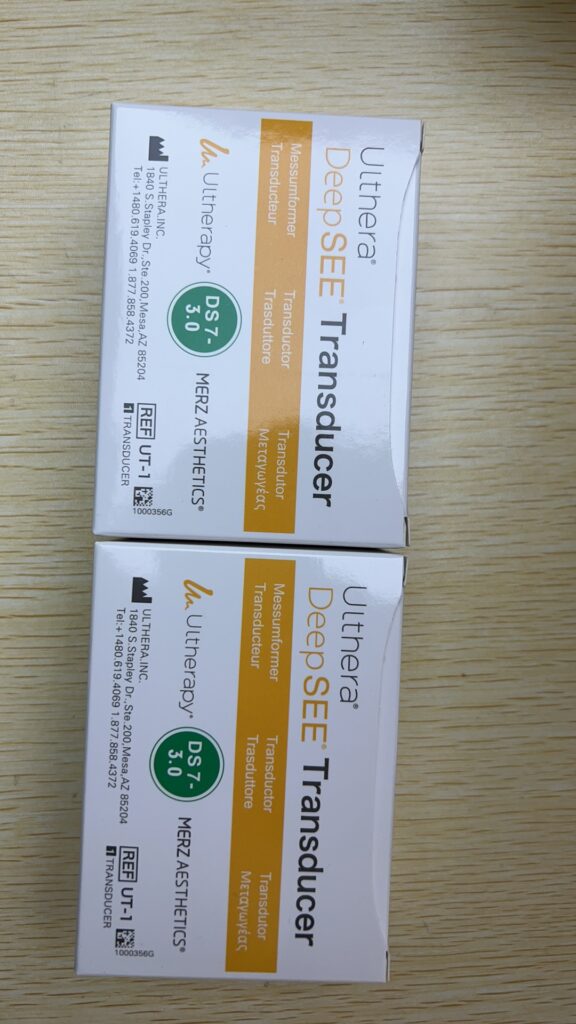
For clinic owners evaluating Ultherapy, the DS 7-4.5 transducer is designed to focus microfocused ultrasound energy at the 4.5 mm SMAS layer with a narrow focal zone, limiting bulk heating in the overlying subcutaneous fat and helping reduce the risk of facial lipoatrophy when used according to manufacturer guidelines. Its imaging (DeepSEE) and fixed frequency-depth pairing support consistent, repeatable energy delivery while allowing operators to visualize tissue layers and avoid deeper structures. Procurement decisions should weigh this safety profile against maintenance, consumable cost per line, and sourcing channel (new vs certified pre-owned) to protect both clinical outcomes and asset value.
What the DS 7-4.5 Does and Who It’s For
- The Ulthera DS 7-4.5 is a DeepSEE (purple) transducer for the Ultherapy system operating at 7 MHz with a 4.5 mm treatment depth and visualization up to roughly 8 mm beneath the skin.
- It is intended for non-invasive lifting and tightening by targeting the SMAS or deep dermal structures using microfocused ultrasound, creating discrete thermal coagulation points that stimulate neocollagenesis.
- DeepSEE imaging enables visualization of tissue layers, helping operators verify coupling, adjust handpiece positioning, and avoid bone or unintended depth targets.
- Ideal users include aesthetic clinics and dermatology practices that already deliver or plan to add non-surgical facial lifting and wish to differentiate from generic HIFU by using an established, imaging-guided platform.
- The DS 7-4.5 is particularly relevant in midface, jawline, and lower-face lifting protocols where SMAS engagement is desired while aiming to protect superficial fat compartments when treatment parameters are respected.
For procurement teams, this cartridge is not a standalone device but a high-value consumable that directly conditions procedure safety, patient experience, and the perceived quality of your Ultherapy service line. Working with a solutions partner like ALLWILL helps align device platform, transducer inventory, and maintenance strategy to your clinic’s volume projections and risk profile.
Core Technical Physics: Narrow Focal Zones, SMAS Targeting, and Fat-Sparing Logic
- Microfocused ultrasound concentrates acoustic energy at a controllable depth, raising tissue temperature at the focal zone to around 60–70 °C while keeping intervening layers below coagulative thresholds when parameters are optimized.
- The DS 7-4.5 couples a 7 MHz frequency with a 4.5 mm focal depth; higher frequency supports a smaller focal volume and shallower penetration, contributing to a tighter focus at the SMAS with limited lateral spread.
- A narrow focal zone means most of the energy converts to heat within a small ellipsoid at the intended depth, rather than diffusing broadly through the subcutaneous fat layer.
- Treatment lines are delivered as a series of discrete coagulation points separated by non-treated tissue, allowing heat to dissipate and reducing cumulative bulk heating of surrounding fat compartments when pass counts are appropriate.
- DeepSEE imaging adds a real-time feedback loop—operators can visualize the interface between dermis, subcutaneous tissue, and deeper fascia, reducing the risk of unintentionally depositing energy closer to the skin surface or periosteum.
For clinics concerned about hollowing or contour changes, the physics of a well-collimated, 4.5 mm focal depth used within protocol helps support selective thermal effect in fibromuscular layers rather than broad lipolytic exposure in superficial fat. However, this protection is contingent on conservative energy settings, correct transducer choice, and operator training.
Does HIFU/Ultherapy Cause Facial Fat Loss? Mechanisms and Mitigation
- Reports of facial volume loss after HIFU-type procedures appear related to parameters that concentrate energy in superficial fat compartments, including inappropriate cartridge choice, high cumulative energy, or off-label body-depth cartridges applied to the face.
- Generic HIFU platforms may provide less consistent imaging or broader focal zones, increasing the risk of non-selective heating if operators cannot visualize target layers.
- Ultherapy’s design—with defined cartridges (1.5, 3.0, 4.5 mm) and imaging—aims to confine energy to specific structural layers, but untrained use, excessive stacking of lines, or improper transducer selection can still increase risk.
- At 4.5 mm, the DS 7-4.5 generally targets SMAS and deep fibrous tissues rather than the more superficial malar and buccal fat pads; however, facial anatomy varies and conservative protocol design is essential.
- Many clinical series report skin tightening and lifting without significant long-term fat atrophy when parameters follow manufacturer guidance and patients are appropriately selected.
Clinic decision-makers should treat facial fat preservation as both a training issue and a device-selection issue: the DS 7-4.5 can be part of a fat-sparing strategy, but only if paired with ultrasound imaging use, protocol discipline, and ongoing staff competency checks.
Revenue and Operational Impact: Payback Math Around Safe SMAS Targeting
- A DS 7-4.5 transducer is typically rated for a fixed number of lines or shots per cartridge (often in the low-to-mid five-figure range), which translates directly into cost per treatment once your protocol is defined.
- Market data and reseller disclosures suggest ballpark replacement costs in the low thousands of dollars (for example, around 2,000–3,000 USD per new transducer), with some vendors indicating per-cartridge costs near 2,300 USD.
- Recertification or onboarding fees for Ultherapy platforms in some markets have been reported in the tens of thousands of dollars (for example, around 20,000 USD) when ownership changes; this should be factored into total cost of ownership.
- Clinics commonly position Ultherapy as a premium, non-surgical lifting service, often priced significantly above entry-level HIFU due to brand recognition, imaging, and perceived safety margin; per-session pricing can vary widely by region and practice model.
- When facial fat is preserved and lifting outcomes align with expectations, patient satisfaction and word-of-mouth can sustain higher utilization, shortening payback periods on both the platform and the recurring DS 7-4.5 transducers.
Because utilization is the main lever on ROI, a sourcing partner like ALLWILL can help map cartridge inventory to realistic booking forecasts, reducing idle capital in unused consumables and aligning replacement cycles with manufacturer recommendations. Request a quote from ALLWILL for current DS 7-4.5 pricing, estimated cost per treatment line, and options for integrating transducer supply into a broader Ultherapy asset plan.
Why the DS 7-4.5 Supports a Higher-Ticket Positioning
- Deep imaging capability (up to about 8 mm) differentiates DS 7-4.5–based Ultherapy from many basic HIFU devices that lack visualization and rely purely on external landmarks, which can be less predictable over variable facial anatomy.
- The fixed 7 MHz/4.5 mm pairing reflects a design commitment to selective SMAS targeting rather than broad, adjustable-depth fat heating, supporting more consistent lifting-oriented protocols.
- Manufacturer-supported treatment guidelines and clinical literature help underpin a more structured training and credentialing ecosystem compared with some generic platforms, which can strengthen your clinic’s risk management story.
- Patients often recognize the Ultherapy brand and may perceive it as more established, allowing clinics to sustain premium pricing and differentiate from lower-cost HIFU offerings while emphasizing imaging-guided safety.
- When sourced and maintained correctly, a Ultherapy platform with DS 7-4.5 cartridges can become a cornerstone procedure, supporting cross-sell into injectables, skincare, and maintenance treatments without relying on aggressive energy delivery.
ALLWILL’s role is to help align this higher-ticket rationale with your actual local demand, ensuring that the investment in DS 7-4.5 cartridges and supporting hardware is grounded in realistic volume and payback expectations.
BME Technical Maintenance Checklist for DS 7-4.5 and Ultherapy Platforms
Because this article is driven by engineering and clinical side-effect concerns, the most useful decision tool is a technical maintenance checklist your biomedical engineering (BME) or technical lead can adopt when managing Ultherapy systems and DS 7-4.5 transducers.
Ultherapy DS 7-4.5 Maintenance & Safety Checklist
| Checklist Area | Key Actions (Engineering-Focused) | Operational Impact |
|---|---|---|
| Transducer ID & Traceability | Record DS 7-4.5 serial, manufacture date, and batch in asset register at receipt; verify compatibility with your Ultherapy console. | Supports recall management, warranty claims, and compliance audits. |
| Shot/Line Counter Monitoring | Track lines used per DS 7-4.5 against manufacturer-rated maximum; retire or service transducers before exceeding limits. | Reduces risk of under-delivery or inconsistent focal heating that might compromise outcomes. |
| Imaging Quality Check | Before clinical sessions, verify DeepSEE imaging clarity at standard settings on a test medium; flag degraded image quality. | Poor imaging can increase risk of mistargeted energy and unintentional fat or bone heating. |
| Output Consistency Test | At scheduled intervals, run a phantom or manufacturer-recommended test to confirm focal depth and energy output remain within tolerance. | Helps prevent drift in focal depth that could increase lipoatrophy or safety risk. |
| Handpiece & Cable Inspection | Visually inspect connectors, cable strain points, and handpiece housing for wear or damage; log and address anomalies promptly. | Minimizes unexpected downtime and reduces risk of intermittent output. |
| Coupling Medium Protocol | Standardize approved ultrasound gel types, storage, and expiration checks; avoid air bubbles by defined application technique. | Ensures reliable acoustic coupling and consistent energy transfer across treatment lines. |
| Console Software & Logs | Keep firmware updated per manufacturer guidance; review error logs regularly; store configuration backups. | Supports system stability and clear root-cause analysis in event of anomalies. |
| Cleaning & Disinfection | Follow IFU for between-patient cleaning, approved agents, and contact times for DS 7-4.5 and handpiece. | Protects patient safety and avoids material degradation that could affect performance. |
| Environmental Conditions | Maintain console and transducers within recommended temperature and humidity ranges; avoid shock/vibration in storage. | Preserves piezoelectric elements and electronics, prolonging transducer lifespan. |
| Third-Party Service Validation | If using non-OEM service, verify calibration certificates and test reports; retain documentation with asset file. | Demonstrates due diligence in audits and supports defensible risk management. |
A partner like ALLWILL can help convert this checklist into a scheduled maintenance plan, integrate it with your broader device fleet, and coordinate calibration, service, or transducer replacement while minimizing downtime.
Compliance, Regulatory Status, and Asset Protection
- The Ultherapy system and its transducers, including DS 7-4.5, have been cleared in various regions (such as FDA 510(k) in the United States) for specific lifting and tightening indications; however, regulatory status and indications can differ by market and over time.
- Clinic owners should verify the current regulatory status of any unit and its consumables in writing with the manufacturer or authorized distributor, especially when acquiring certified pre-owned equipment.
- For CPO transducers, documentation should include original device identifiers, prior use or refurbishment process, compatibility confirmation with your console version, and proof that the shot counter and lifespan are accurately represented.
- Asset protection extends beyond equipment integrity to clinical governance: documenting training on focal-zone physics, SMAS targeting, and fat-sparing protocols can be important in managing medico-legal risk.
- Insurance carriers may expect evidence of regular maintenance, calibration, and traceability of consumables like DS 7-4.5, making well-kept logs and third-party service reports a core part of your risk strategy.
ALLWILL can assist by sourcing devices and consumables through documented, verifiable channels and by coordinating with manufacturers or certified engineers to secure the necessary compliance and service records for your files.
Procurement Risks to Avoid and ALLWILL Expert View
- Purchasing expired or near-end-of-life DS 7-4.5 transducers without clear disclosure can erode ROI by shrinking usable line counts and increasing early replacement needs.
- Acquiring Ultherapy platforms without understanding manufacturer recertification policies can result in unexpected onboarding fees (for example, around 20,000 USD in some cases), materially changing your total investment.
- Unverified “compatible” cartridges or third-party modifications may compromise focusing accuracy, potentially increasing the risk of fat atrophy or inconsistent outcomes while voiding manufacturer support.
- Underestimating maintenance and calibration needs can lead to subtle performance drift—energy reaching slightly shallower or deeper layers than intended—without obvious device alarms.
- Fragmented sourcing (device from one channel, cartridges from another, service from a third) increases friction whenever an issue arises and can complicate who is accountable for resolving performance or safety concerns.
ALLWILL Expert View: Building a Fat-Sparing Ultherapy Asset Strategy
For clinic owners, the DS 7-4.5 is not just a consumable; it is the sharp edge of your Ultherapy value proposition. The focal physics, imaging, and SMAS targeting all sit inside that cartridge. To minimize the risk of undesired fat loss while protecting ROI, decision-makers should look at three layers: first, platform provenance and recertification obligations; second, a transducer roadmap linked to realistic treatment volume and lifespan; and third, a maintenance and calibration schedule that directly references focal-zone verification and imaging quality. By aligning these layers before purchase—rather than reacting after a complication or breakdown—you can keep your Ultherapy service positioned as a premium, low-downtime option without over-buying inventory or accepting hidden engineering risks. A solutions partner like ALLWILL can help stress-test your business case with current market pricing, CPO availability, and service options so your first DS 7-4.5 order is part of a coherent three-to-five-year asset plan, not a one-off consumable purchase.
Mid-funnel buyers can reduce uncertainty substantially by requesting a quote from ALLWILL that includes not only pricing but also a draft maintenance roadmap and transducer usage model tailored to their projected Ultherapy procedure volume.
Frequently Asked Questions
How much does a DS 7-4.5 Ultherapy transducer cost?
Market observations suggest that new DS 7-4.5 transducers often fall in the low-thousands of dollars per unit, with some vendors disclosing prices around 2,000–3,000 USD depending on channel and terms. Actual pricing varies by region and contract, so it is advisable to request a quote from ALLWILL for current figures and availability.
Can I use certified pre-owned DS 7-4.5 transducers safely?
Certified pre-owned DS 7-4.5 units can be used safely when their provenance, remaining line capacity, compatibility with your console, and refurbishment process are clearly documented and verified. Buyers should confirm these points in writing, including any warranty or return conditions, before committing to a CPO purchase.
How do I reduce the risk of facial fat loss with Ultherapy?
Risk mitigation centers on correct cartridge selection (for example, DS 7-4.5 for SMAS), conservative energy settings, adherence to manufacturer protocols, and routine imaging-based depth confirmation. Comprehensive operator training and periodic competency reviews are essential, and some clinics work with partners like ALLWILL to integrate technical and clinical guidance into their onboarding.
What is the payback period for adding Ultherapy with DS 7-4.5 to my clinic?
Payback depends on local pricing, booking volume, financing terms, recertification fees, and transducer consumption rates. Many clinics treat Ultherapy as a premium anchor service and target a multi-year asset horizon; a tailored ROI model from ALLWILL based on your anticipated case numbers can clarify expected payback before you invest.
Are there alternatives to Ultherapy using similar technology?
Yes, various HIFU and microfocused ultrasound systems exist, including multi-depth “4D” or “7D” HIFU platforms that offer multiple cartridges for facial and body indications. However, imaging capability, regulatory status, and focal-zone control differ, so buyers should compare not only price but also physics, clinical evidence, and support infrastructure when evaluating alternatives.
References
- Transducer DS 7 – 4.5 Product Detail
- Rock Bottom Lasers – Ulthera Ultherapy Transducers Overview
- Ulthera, Inc. – Ultherapy Instructions for Use (IFU)
- Micro-Focused Ultrasound Skin Tightening – PRIME Journal
- Compilation of Clinical Studies on Focused Ultrasound (UF3)
- 4D HIFU Machine – Technical Specifications
- Deep Heating and Focused Ultrasound – Technical Whitepaper
- Latest Portable 7D Hifu User Manual
- ALLWILL Microfocused Ultrasound (MFU-V) Supply Chain Initiative
Related articles
 How to Compare Quotes for the Same Used Aesthetic Device ModelKnowledge
 Used Medical Aesthetic Device Condition Grades: New, Like-New, Excellent, Working, and PartsKnowledge
 Eufoton Endolift Lasemar 1500 L: Reading Prices and Building the Right QuoteKnowledgeEndolift Lasemar Used-Unit Checks: Fiber Kits, LightScan, and Distributor EvidenceKnowledge